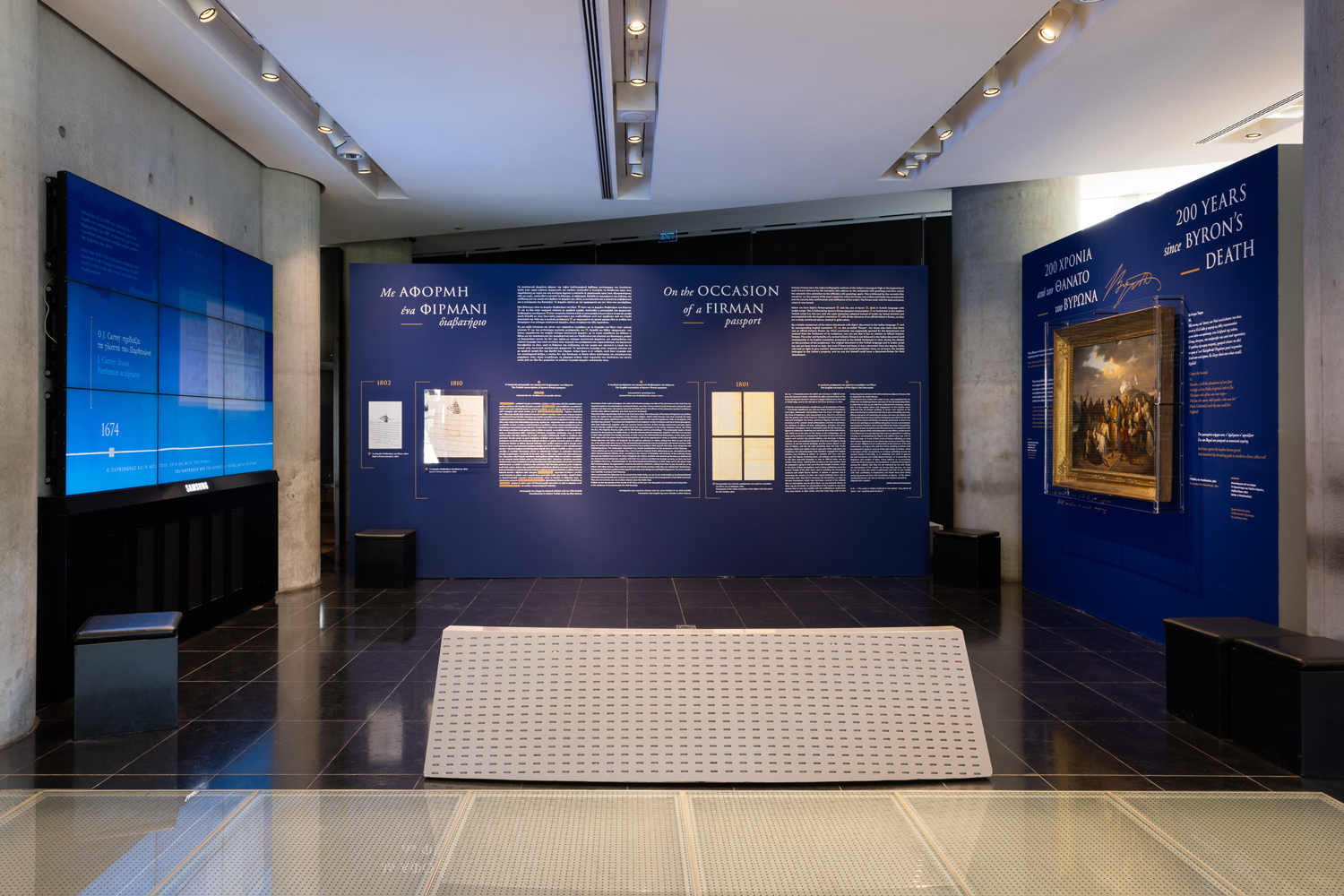
Since April 2024, visitors to the Acropolis Museum's ground floor have been able to admire a small but carefully staged exhibition: The Parthenon and Byron. Its centrepiece is genuinely moving — Byron's own travel pass through Ottoman territory, an authentic document issued in 1810, unveiled to the public for the first time and interpreted by the Ottoman historian Ilias Kolovos. Professor Nikolaos Stampolidis, the Museum's director and the exhibition's author, places it beside a reproduction of the document Lord Elgin relied upon, inviting the visitor to compare the two and draw their own conclusion about which one looks like a genuine Ottoman authorisation.
It is elegant museum-craft. It is also, on close inspection, a fifty-year-old argument dressed up as a discovery.
An old argument in a new frame
The claim that Elgin's document is not, technically, a firman did not begin at the Acropolis Museum. It was made with considerable rigour by Professor Vassilis Demetriades of the University of Crete, whose analysis was appended to a 2000 report of the House of Commons Culture, Media and Sport Committee on the return of cultural property. Demetriades catalogued the formal features that distinguish a genuine firman — chiefly the Sultan's own cipher, or tughra, and a fixed compositional structure — and found none of them present in the surviving translation of Elgin's document. His conclusion was precise: what has come down to us is not a firman but a mektub, an official letter, and one that in his reading carried no independent force of law.
It is a serious argument, made by a serious scholar, a quarter of a century before Stampolidis put Byron's passport in a display case beside it. What the exhibition adds is not new evidence but a visual aid: a real firman-format document, so that an unfamiliar reader can see at a glance that Elgin's does not match it.
The trouble is that the comparison invites the wrong conclusion. Byron's document was a passport — a standard travel authorisation, of a kind the Porte issued routinely to foreign visitors, and naturally composed to a template. Elgin's document, on the specialists' own telling, was never claimed to be that kind of instrument at all. Dyfri Williams, who has examined the case in the greatest technical depth, concedes readily that the surviving text does not meet the formal definition of a firman, but suggests it more probably belongs to a different class of Ottoman order altogether, the vizierial buyuruldu, issued not by the Sultan directly but by his Grand Vizier or deputy. Comparing a passport to a buyuruldu and finding them dissimilar tells us only that two different kinds of Ottoman paperwork looked different from one another. It tells us nothing about whether either one carried authority.
What the archives and the men on the ground actually show
Here the argument moves from labels to substance, and substance favours Elgin. Edhem Eldem, in his study of Ottoman attitudes to antiquities, has worked directly from material recently located in the Istanbul archives, including a copy of the order sent to Athens. His reading is that the Ottoman government treated Elgin's request as an ordinary matter of settling a property claim, now that peace with Britain had been restored — hardly the posture of an administration issuing a meaningless scrap of paper.
Then there is the detail I find most decisive, and which none of the terminological debate actually touches: the document was addressed not merely to the Voivode, the civil governor, but also to the Qadi, the local judge. A judge has no business being named in a courtesy note. His inclusion only makes sense if there was something of a genuinely legal character for him to have cognisance of.
More telling still is who carried the thing to Athens. It did not simply arrive in the post. It was delivered by a mubashir, Raschid Aga, a court official whom Williams's research shows outranked both the Qadi and the Voivode he was sent to visit. The Reverend Philip Hunt, who accompanied him, recorded plainly that Raschid Aga's task was to see that its contents were obeyed. One does not despatch a high-ranking Porte official, superior in rank to the two local dignitaries he calls upon, to babysit a letter with no force behind it. The seniority of the messenger is itself a form of evidence, and it points the same way as Eldem's archives: this was understood, at the time, by the people who mattered, as an instruction to be followed at their peril, not a suggestion to be politely considered.
Alexander Herman, in the most recent and most balanced full-length legal treatment of the dispute, reaches a similar landing point by a different route, and states it plainly. Asked directly about the document on the Art Law Podcast in 2024, he put his conclusion in exactly these terms: it does have legal force, because it came from the deputy Grand Vizier. The label is negotiable. The effect, on his own account, was not.
Back to Byron
Which returns us, appropriately, to the poet Stampolidis has enlisted for the opposing case. Byron loathed what Elgin had done, and said so in verse more memorable than anything a select committee ever produced. But look closely at what he actually wrote about the firmans themselves, rather than at the moral fury he built around them.
In his own prose note to the second canto of Childe Harold's Pilgrimage, mocking the unseemly scramble of rival antiquarians then descending on Athens, Byron wrote that the city's fall was nowhere more visible than in the sight of two painters contesting the privilege of plundering the Parthenon, and triumphing in turn, according to the tenor of each succeeding firman. Read that sentence again: it is Byron, in a note published under his own name, treating the firmans not as forgeries to be exposed but as real instruments whose tenor — their actual content — determined who was entitled to remove what from the building. He is disgusted by the fact of the plundering. He never once suggests that the paperwork authorising it was fictitious.
His private jottings go further still, and sit rather awkwardly with the modern narrative built around him. In a marginal note in his own copy of the poem, in what his editors describe as his last recorded reflection on the affair, Byron can be found weighing Elgin's own stated purpose — to instruct the English in Sculpture — turning it over with a characteristic aside about the English being about as capable of sculpture as the Egyptians are of skating, before catching himself and asking, half in self-mockery, why he had entertained the argument at all. This is not an endorsement of Elgin's methods; Byron's real objection, in the same note, stayed resolutely aesthetic — the ruins, he writes, are less poetical without their sculptures, wherever the sculptures themselves now sit. But it shows a man willing to hold Elgin's own justification in his head long enough to argue with it. That is a very different, and much more interesting, posture than simply denying Elgin ever had permission to act — and it is a far weaker foundation for the modern restitution case than Stampolidis's exhibition would have visitors believe.
It is worth naming the technique on display here, because it will not be the last time we see it. Produce one genuine historical document, place a contested one beside it, and let the visual mismatch do the arguing that the evidence itself cannot quite manage. Byron's passport is real, and rather wonderful. It is just not a rebuttal.
Bibliography
Cochran, Peter (ed.), The Curse of Minerva, annotated edition [PDF]. Includes transcription and discussion of Byron's marginal note to his own copy of Childe Harold's Pilgrimage.
Demetriades, Vassilis, in Cultural Property: Return and Illicit Trade, Seventh Report of the House of Commons Culture, Media and Sport Committee (London, 2000), Appendix, Annex A.
Eldem, Edhem, "From Blissful Indifference to Anguished Concern: Ottoman Perceptions of Antiquities, 1799–1869," in Zeynep Çelik, Edhem Eldem and Zainab Bahrani (eds), Scramble for the Past: A Story of Archaeology in the Ottoman Empire, 1753–1914 (Istanbul: SALT/Garanti Kültür, 2011).
Herman, Alexander, The Parthenon Marbles Dispute: Heritage, Law, Politics, The Art Law Library (Oxford: Bloomsbury/Hart, 2023), ch. 3, "A Firman by Any Other Name."
Herman, Alexander, interviewed by Steve Schindler and Katie Wilson-Milne, "The Parthenon Marbles Dispute," The Art Law Podcast, 4 March 2024.
Lord Byron, Childe Harold's Pilgrimage, Canto II, prose note 161, in The Works of Lord Byron: Poetry, ed. Ernest Hartley Coleridge and Rowland E. Prothero, vol. 2 (London: John Murray, 1898–1904).
Stampolidis, Nikolaos Chr., The Parthenon and Byron: On the Occasion of the 200th Anniversary since Byron's Death, exhibition booklet (Athens: Acropolis Museum, 2024).
Williams, Dyfri, "Lord Elgin's Firman," Journal of the History of Collections 21, no. 1 (2009): 49–65.
.jpg)


